


Let’s start by looking at the numbers WordPress.org was able to achieve, as Nicholas Garofalo mentioned in his post – How AI and Automation Spotlight the Best of WordPress:
- 2.4 million combined followers across WordPress social channels.
- 14,000 to 117,000+ subscribers on the WordPress YouTube channel – that’s a whopping 736% increase.
- Related to the above: 5× increase in annual watch time after automating content publishing and distribution.
- 600,000+ annual visitors to the WordPress Showcase.
- 1.3 million page views annually.
Those are healthy numbers. I’d love to know if visits to the showcase have increased too, as well as the combined followers count.
Jamie Marsland, Head of WordPress.org YouTube at Automattic, deserves a lot of the credit for the channel’s success. His content is great.
Why is this important? Because distribution is becoming just as important as creation, particularly at a time when AI is making it both easy and hard to do both. What Nicholas just shared is that it’s possible to do at scale using AI and automation.
How the WordPress project uses AI and automation
The post doesn’t go into the details but shares this:
Each platform has its own audience expectations, content formats, and norms. In recent years, we’ve built a series of automated workflows (hat tip to Zapier) to collect content from dozens of sources and AI prompts to generate unique drafts that respect each platform’s conventions. The resulting amplification requests are tracked in the Marketing GitHub repository. The result is that when someone in the WordPress community ships a release, publishes a Showcase entry, or organizes an event, their work reaches 2.4 million followers across platforms without significant delay. Recently, our confidence in these workflows has grown to the point that some content, such as releases, is auto-posted immediately.
I was going to say that I’ll try and figure out the workflow and mechanics but will do this instead: help out (and learn by doing so).
Here’s where all the magic happens on GitHub. It’s a screenshot of all closed items.
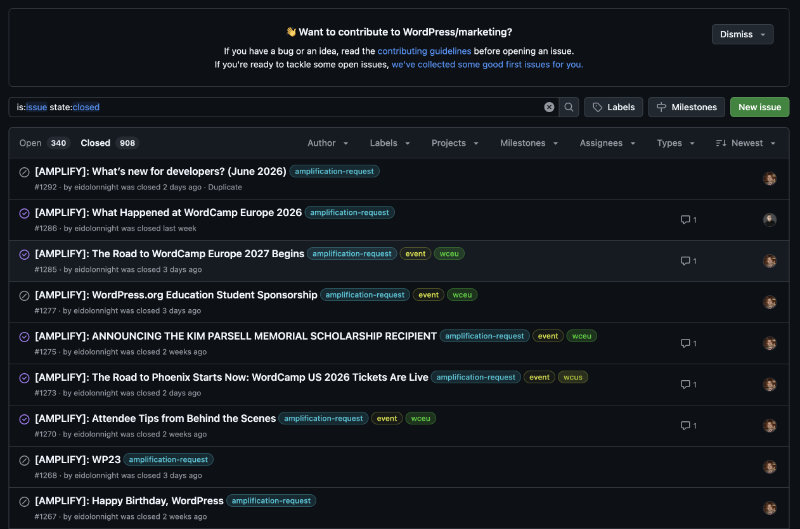
Notice the amplification-request tag? That may trigger an automated distributed workflow.
How does one create a distribution system?
Most of you reading this are devs or technically minded, and models are already forming in your head at this point – admit it! You’re also thinking about the platforms you need to string together. Stop!
It’s not straightforward. Don’t start with the mechanics. You need to put your Information Architect’s hat on and define a content model that spans across channels and formats. You need to work out audience segments and taxonomies to be able to package and deliver the right information to the right folks. SEO and AIO need to work too. You need to think and plan in a structured way so that it will fit nicely into workflows.
How do you do this? Well, I have my own approach. I’m not quite ready to share it as I am re-thinking it and re-building it for 2026 (the year AI changed everything). Here’s what an older system looked like in Airtable:
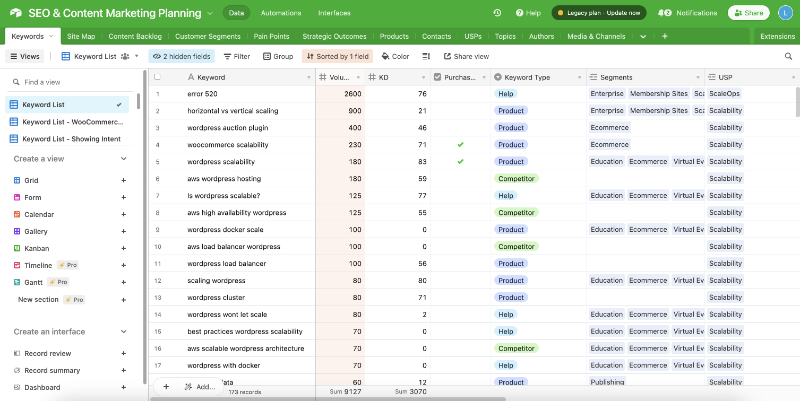
This was 2021 circa. If you know me and where I worked you will figure out who this was for.
This is a view of keywords – familiar to most – but what’s important in this model is the business context associated to each and the content that was published. Starting with Strategic Outcomes, the objective content should help achieve. And including products (and their USPs), segments, and broader topics (topic clusters). This is the business context AI needs to generate better quality content that supports and drives commercial outcomes.
What the model didn’t do is help with distribution. It was only a planning tool. But it wouldn’t take long for it to become one.
WordPress as the brains for content marketing (a big opportunity)
Make WordPress Marketing are using GitHub. I’m building out my system in Notion because it allows me to keep everything – content and planning – in one location, and have AI help with the various workflows. Notion have recently announced a suite of developer tools which gives it all the superpowers it needs to distribute at scale.
I would rather be using WordPress. It’s possible to do so, but a fair amount of work to set it up. Maybe this is a project for someone who has time and resources? Worth looking into it, IMHO, given the new marketing playbook is to do it in places you don’t own or control, as Rand Fishkin advises (on LinkedIn, and not his own platform).
Want proof? Well, you’re reading it. Go back over the numbers I shared at the start of this piece.
I’m going to conclude with a bit of a call to action: there are thousands of businesses out there that are trying to solve the content distribution challenge – let’s make WordPress the best platform for it.
Shameless self promotion
- If you need help and you’re looking to revisit / plan your content marketing plan give me a shout.
- I’ve put together a Debug your Marketing consultancy package to help smaller WordPress businesses get their marketing fundamentals right
- I’ll be sharing my Notion template for Marketing once I’m done. Join as a Pro member (which is free) to get a copy.