

The 20i 2026 Web Designer Survey polled 500 US web design professionals across all sectors and employment types. The findings make for interesting reading – and when set alongside data from the WordPress ecosystem, a revealing contrast starts to emerge.
Please note: bear in mind the US focus when reading the survey report. A global survey would yield different numbers, no doubt.
TL;DR
- Web designers are earning well in 2026 – over a third make $100k+, and nearly 80% feel fairly paid
- AI is the dominant concern, with 75% saying it has already impacted their business this year
- Finding quality clients and managing budgets are growing challenges, but the profession is broadly resilient
- WordPress professionals tell a different story – under 10% earn six figures, and most charge less than $5k per site
- The WordPress community is more likely to embrace AI as a tool than fear it as a threat
- Platform confidence in WordPress is shaky, with only 63% optimistic about its future
- But many WordPress professionals are motivated by more than money – open source and the mission to democratise publishing run deep
Pay: a profession holding its value
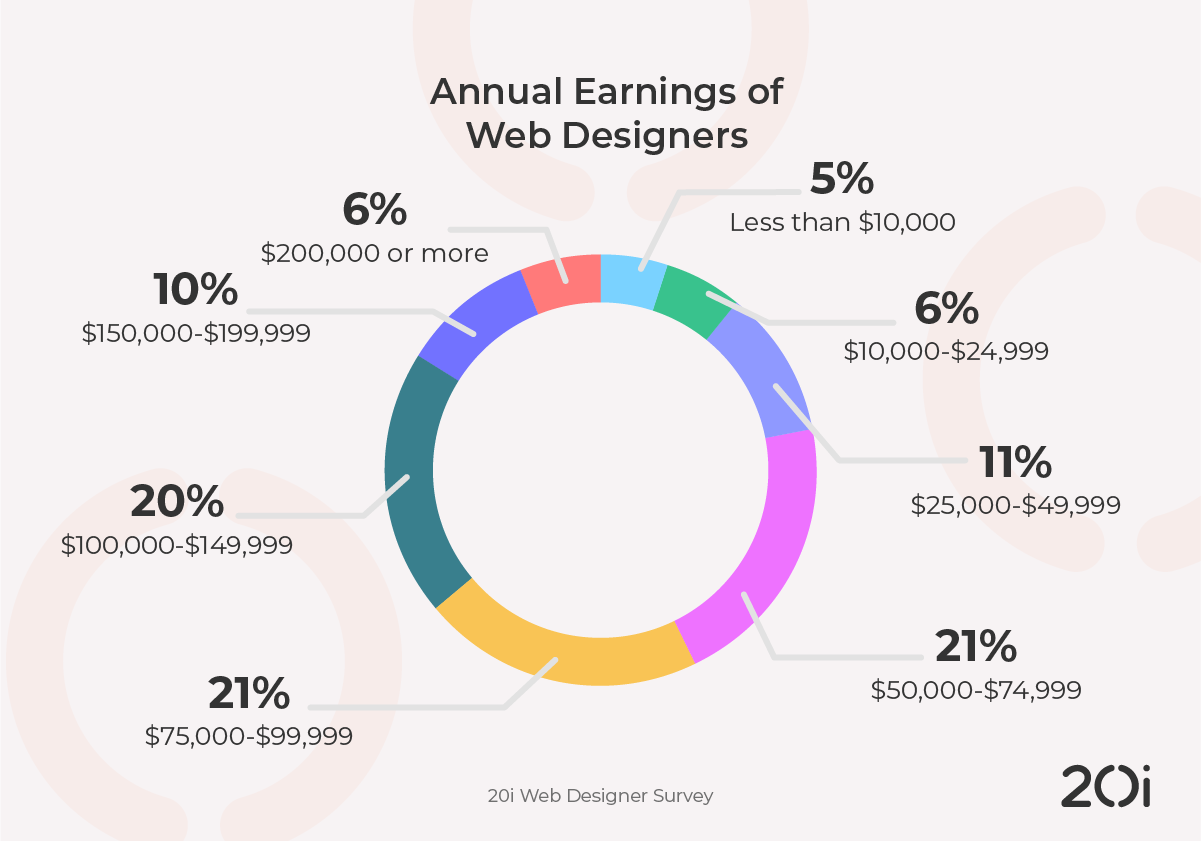
One of the headline findings from 20i is that professional web design pays well. Over a third of respondents earn more than $100,000 per year, with 6.4% clearing $200,000 – a distinct high-earning segment made up largely of agency founders, senior in-house leads and strategic consultants. Nearly 79% say they feel properly compensated for their work.
That satisfaction, however, sits alongside a persistent tension with clients. A striking 89% of respondents agreed that clients underestimate the true cost of web design – suggesting that fair compensation is often won through negotiation rather than freely given.
Designers believe clients prioritise turnaround time (32%) and price (27%) above almost everything else, leaving quality, UX and long-term strategy as secondary concerns in early project conversations.
Regionally, Florida leads on average earnings at $109,938, narrowly ahead of California ($106,346) and New York ($102,067). Texas lags behind at $84,453 – yet reports the second-highest pay satisfaction in the survey, a reminder that perceived fairness is as much about local expectations and cost of living as it is about the number on a payslip.
AI: present tense, not future tense
AI dominates the findings to a degree that sets it apart from every other concern. Three in four designers say AI-driven competition has already impacted their business in the past year. 76% cite it as their biggest concern for the future – significantly ahead of rising software costs (46%) and declining marketing budgets (35%).
Looking a decade out, respondents ranked “AI-agent dominance” and “AI-powered self-design” as the two forces most likely to reshape the industry by 2036 – ahead of hyper-personalised interfaces, privacy-first design and even spatial web and AR. The message is clear: AI isn’t a distant disruption. It’s already here, and designers know it.
That said, a small but notable counter-signal is buried in the lead generation data. Almost one in ten respondents now say AI chatbot referrals are their primary source of new work – a sign that, for some, the same technology driving anxiety is also opening doors.
Sentiment: cautious but not pessimistic
Despite the competitive pressures, the overall tone of the 20i data is one of resilience rather than crisis. Earnings are strong, satisfaction is high, and the ceiling for top earners appears to be expanding rather than contracting. The challenges – 72% say finding quality clients has been harder, 66% cite tighter budgets – read more like friction than structural collapse.
Remote and flexible working has become the default: 65% of designers now work fully remote or on a flexible hybrid basis, with the office reserved as a resource rather than a daily destination. And 78% say they would be willing to move state for the right opportunity, suggesting the profession remains ambitious and mobile.
How the WordPress world compares
Set these findings against data from The Admin Bar’s annual WordPress Professionals Survey (2025) – the most comprehensive look at freelancers, solo operators and small agencies in the WordPress ecosystem – and the contrast is stark.
Where the 20i survey shows over a third of designers earning six figures, The Admin Bar’s data puts fewer than 10% of WordPress professionals in that bracket. Over 42% generated less than $50,000 in total revenue in 2024. The average hourly rate was $94 – down slightly on the previous year – and most charged less than $5,000 per website.
However, The Admin’s bar attracted responses from a global audience. Numbers of a US segment would look closer to 20i’s findings.
On AI, the WordPress community tells a subtly different story. Over 57% of respondents said they are now actively embracing AI in their agencies – suggesting adaptation more than anxiety. That makes sense: solo operators and small agencies have a direct financial incentive to adopt tools that save time and help them compete with larger outfits.
But the bigger difference is platform confidence. While the 20i survey reflects a profession broadly secure in its future, WordPress professionals are navigating genuine uncertainty about the platform they’ve built their businesses on. Only 63% expressed optimism about WordPress’s future – a respectable number, but one coloured by a year of governance disputes and community tension.
The mission that money can’t measure
The pay gap between general web design and the WordPress ecosystem is real, and the data doesn’t flatter the latter. But it misses something important.
Many WordPress professionals aren’t simply accepting lower rates out of inertia. They’re operating within an ecosystem built on a specific idea: that publishing on the web should be open, accessible and free from the control of any single commercial interest. The mission to democratise publishing has drawn developers, designers and builders who are motivated by more than margin.
In that sense, contributing to a WordPress project, building a plugin, supporting the community, or running a small agency on open-source tooling isn’t so different from contributing to an open-source codebase. It’s work done, in part, in service of something larger.
Which raises a question worth sitting with: if open-source contribution is widely recognised as a form of professional and social value, should choosing to build a career within the WordPress ecosystem – accepting the trade-offs that come with it – be considered a form of contribution too?